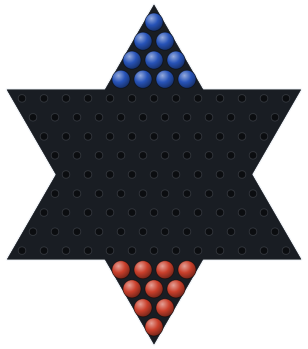
Sternhalma, Halma and Chinese checkers
Three names for closely related games. What each one means, where they come from, and how they differ.
What the name means
Sternhalma is the German name of Halma played on a star-shaped board. Stern is German for star. The name Chinese checkers is the same game under a name given later in the United States.
In Leapstone this is the star board: the board of the Chinese checkers rules.
Where it comes from
- Halma was invented in 1883 or 1884 by George Howard Monks, an American surgeon. The name is Greek for “leap”. It is played on a square board. Read the Halma rules.
- Stern-Halma appeared in Germany in 1892: the same idea on a board shaped like a six-pointed star.
- Chinese checkers is the name Bill and Jack Pressman gave the game in the United States in 1928, at first as “Hop Ching checkers”. The game has no historical link with China, and it is not a checkers game.
How the games differ
- Halma: a square board of 16 by 16 spots, for 2 or 4 players. A piece has eight neighbors, straight and diagonal. With 2 players each has 19 pieces, with 4 players 13.
- Sternhalma and Chinese checkers: a star board of 121 spots, for 2, 3, 4 or 6 players. A piece has six neighbors. Everyone has 10 pieces.
- The rest is the same: a step to a free neighbor, or a jump over one piece, with chains of jumps. The first player to fill the camp across the board wins.
Variants, and what Leapstone does
Halma has been played in more than one way. This is how Leapstone compares with the variants we found in our sources:
- Board size. Halma is also played on 8 by 8 and 10 by 10 boards. Leapstone has only the 16 by 16 board.
- Leaving the goal. In one Halma rule, a piece that has entered the camp of the opponent may not leave it again. Leapstone does not have this rule: you can move such a piece again.
- Three players on a star. An old three-player Halma on a star board is described with 15 pieces each. Leapstone plays 3 players on the star board with 10 pieces each.
- Jumps are your choice. You never have to jump. You pick the spot where your move ends.
Play it in Leapstone
Play now opens a game on the star board against the computer. For the square board, tap the back arrow at the top and pick the Square board in the menu.