Halma rules
Move all your pieces across the square board to the opposite corner before anyone else does. The rules in short, with pictures, and a few tips.
The board
Halma is played on a square board of 16 by 16 spots, 256 in all. Every spot has up to eight neighbors: the four straight ones and the four diagonal ones. A spot on the edge has fewer, and a corner has three.
This is the Square board in Leapstone. If you know the game on the star board, read about Sternhalma and the Chinese checkers rules.
How the pieces start
Halma is for 2 or 4 players. Every player starts with the pieces in a camp in a corner of the board. The camp in the opposite corner is your goal.
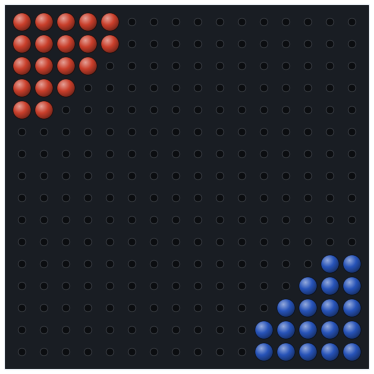
- 2 players: 19 pieces each, in two corners across from each other. The camp is five rows of 5, 5, 4, 3 and 2 spots.
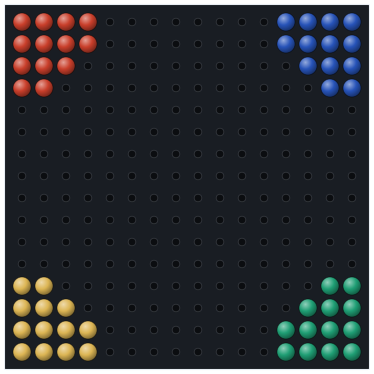
- 4 players: 13 pieces each, one camp in every corner. The camp is four rows of 4, 4, 3 and 2 spots. Your goal is the corner across the board, diagonally.
Taking turns
Player 1 goes first. Then the turns go in order, and after the last player it is Player 1 again. In Leapstone the colors go with the numbers: red, blue, green and yellow.
On your turn you move one piece, once. Nothing is captured: pieces stay on the board until their player resigns.
A step
Move a piece to an empty spot next to it, in any of the eight directions: straight or diagonal.

A jump
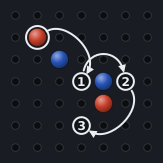
Jump over one piece next to yours, of any color, and land on the empty spot right behind it, in a straight line. You can jump in all eight directions, also diagonally and backwards.
- The spot you land on must be empty.
- You cannot jump over two pieces in a row, or over an empty spot.
- The piece you jump over stays where it is.
- You cannot jump over the edge of the board.

A chain of jumps
After a jump, the same piece may jump again, as many times as it can, in any direction, straight or diagonal. You decide where to stop. All the jumps together are one move.
- In one move you cannot land on the same spot twice.
- A move is one step, or one or more jumps. You cannot step after a jump.
The goal
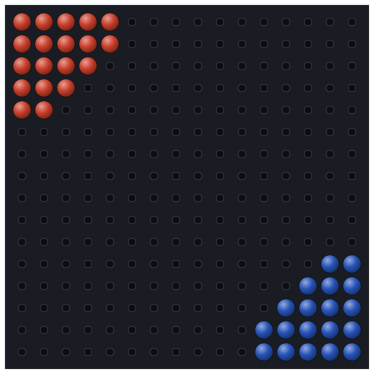
You win by moving all your pieces into the camp across from where you started. Every spot of that camp must hold your own pieces: 19 with 2 players, 13 with 4 players. While a piece of another player sits there, you cannot finish.
You may land on any empty spot, also in the camps of other players. A piece that is in your goal may leave again; nothing locks it.
With 2 or 4 players
- 2 players: the first player to fill the goal wins, and the game is over.
- 4 players: the first player to fill the goal wins. The others play on for the next places, and a player who is done is skipped. The game is over when only one player is still playing.
Resigning
When you resign, your pieces leave the board, so they do not block anyone. With 2 players, the other player wins. With 4 players the game goes on without you, and if everyone but one player resigns, the last player wins.
In an online game every move has a time limit. The player who starts the game sets it. When your time runs out, your turn is skipped. If you miss 3 turns in a row, you resign. Games against the computer and on one phone have no time limit.
Tips
- Build ladders. Put pieces in a line with one empty spot between them, straight or diagonal, pointing at your goal. One piece can then jump along the whole line in a single move.
- Any piece is a ladder. You can jump over every color, so the pieces of the other players help you too. And your own ladders help them: look at what you leave behind.
- Use the diagonals. The goal is in the opposite corner, so a diagonal line of pieces is the fastest way across.
- Do not forget the stragglers. You need all your pieces home. A piece far behind, with nothing to jump over, moves one spot per turn. Bring it along while the other pieces are still around it.
- Your start is their goal. With 2 players, your camp is the goal of the other player, and they cannot finish while one of your pieces is still there. Leapstone lets you keep a piece at home, so you can block this way. The same goes for you.
Play it
The Play now button opens a game against the computer on the star board. To play Halma, tap the back arrow at the top, then choose Play on this phone, Play against the computer or Play online with friends, and tap the Square board.